Role models

On Saturday, December 14th, the International Centre for Advanced Islamic Research (ICAIR) hosted an in-person seminar at The WF House, Moorhall Road, UB9 6NS, featuring Ayatollah Syed Aqeel al-Gharavi. The session explored the enduring relevance of Akhbarism and Usulism—two pivotal intellectual traditions within Shi‘i Islam—and their influence on contemporary debates in Islamic thought. Ayatollah al-Gharavi traced the historical development of these schools, clarifying common misconceptions and highlighting the sophisticated interplay between textual traditionalism and rational inquiry that has defined Shi‘i scholarship. Moving beyond the conventional framing of Akhbaris as strict traditionalists and Usulis as rationalists, he presented a more nuanced picture of how these traditions have evolved and continue to shape legal and theological discourse today.
On Saturday, October 5th, the International Centre for Advanced Islamic Research (ICAIR) hosted an in-person seminar titled “Tawassul and Ziyarah in Islamic Thought” at The WF House, Moorhall Road, UB9 6NS. The evening featured Shaykh Dr Vinay Khetia, who delivered a thought-provoking exploration of the theological and historical foundations of Tawassul (intercession) and Ziyarah (visitation) within the Imami Shiʿa tradition. Dr Khetia examined the Qurʾanic and hadith sources that underpin these practices, their philosophical significance, and their evolution throughout Islamic history. He also discussed the theological debates surrounding intercession, the spiritual and communal role of Ziyarah, and contemporary perspectives on these long-standing traditions. Attendees benefited from an engaging discussion, followed by dinner and fellowship at the venue. The seminar fostered a deeper understanding of how these devotional practices continue to enrich Shiʿa spiritual life and community cohesion.
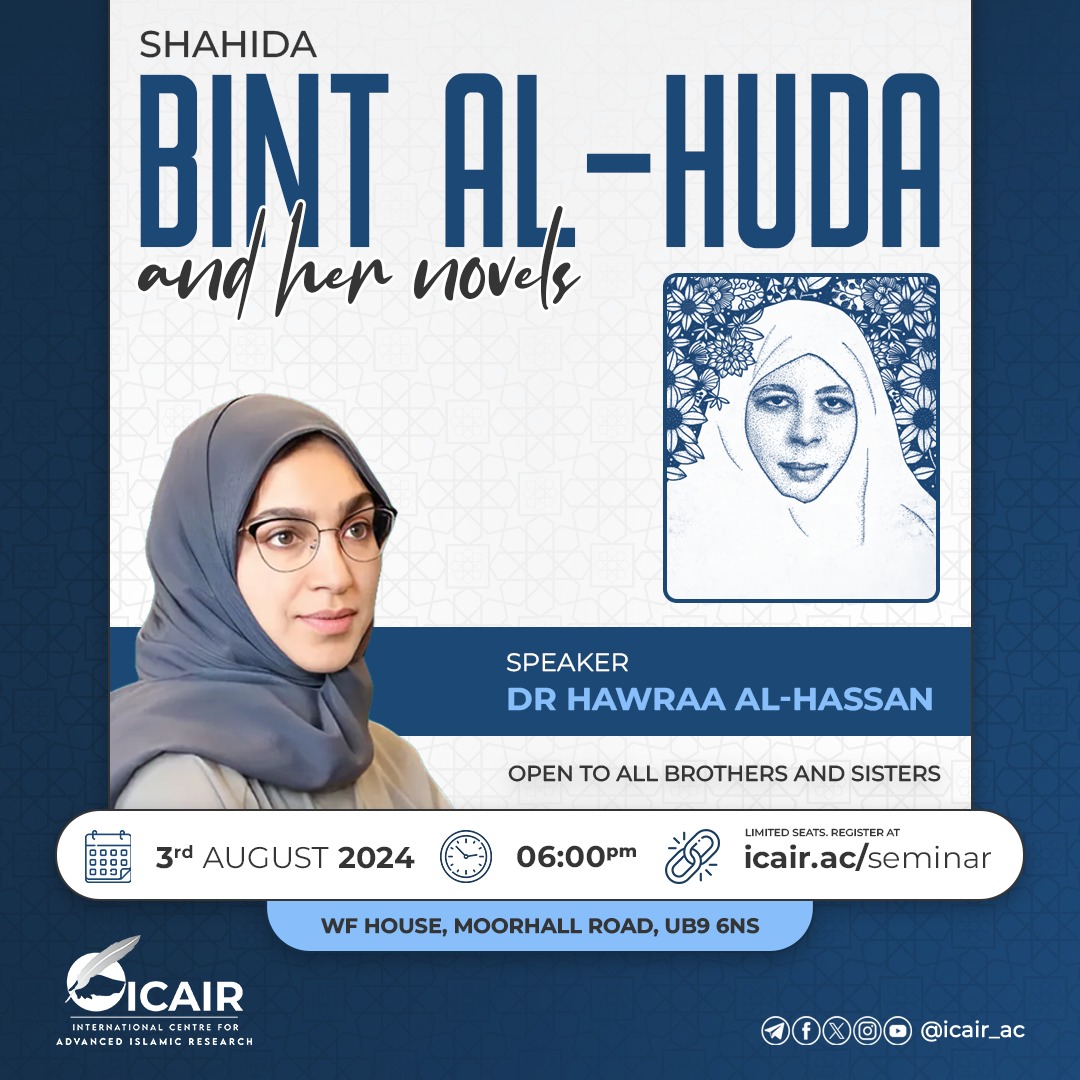
On Saturday, August 3rd, the International Centre for Advanced Islamic Research (ICAIR) hosted an in-person seminar at The WF House, titled “Shahida Bint al-Huda and Her Novels.” The lecture was delivered by Dr Hawraa Al-Hassan, an affiliated researcher at the University of Cambridge, whose scholarship explores how modern Arabic fiction intersects with religion, nationalism, and social change. Dr Al-Hassan discussed how Shahida Bint al-Huda — born Amina Haydar al-Sadr (1938–1980) — used fiction to articulate an Islamic moral vision during Iraq’s secular turn of the 1960s and 70s. Through her novels, she crafted relatable heroines who embodied faith and dignity, and subtly challenged the Baʿth regime’s portrayal of women. Her work, Dr Al-Hassan noted, became both a space of resistance and a refuge for Iraq’s devout, nurturing a sense of identity at a time when religious expression was increasingly marginalised. The seminar invited reflection on how Bint al-Huda’s writing continues to resonate today — as a reminder of the power of literature to preserve faith, shape conscience, and speak truth amid adversity.